The Armor We Wear examines how clothing and adornment move beyond function to become vessels of power, identity, and intention. Curated by Olivia Amaya Ortiz, the exhibition brings together works that reveal intersecting and contrasting narratives—rooted in cultural memory, personal expression, resistance, and renewal. At a time marked by increasing censorship and pressures toward conformity, dress emerges here as metaphor: a woven protest, a declaration of pride, and an enduring mode of self-making.
Opening to the public with a reception at the museum, the exhibition presents new and recent work by eleven local and regional artists: Camryn Growing Thunder (Fort Peck Assiniboine Sioux), Carrie Wood (Diné), Alejandro Macias, Angela Ellsworth, Anthony Hurd, Elizabeth Denneau, Eric J. Garcia in collaboration with Loose Threads Colectivo, Papay Solomon, ruben ulisses rodriguez montoya, Shaunté Glover, and Vicente Telles.
Walking across the University of New Mexico's campus we glimpsed the promotional poster for Winnebago/Choctaw artist Chaz John's aluminum sculpture and painting in the "Spirit House" exhibit. We found that the show had opened that same evening and decided to return during the day to really experience the exhibits at a more chill pace than one can experience at an opening.
Entering the centrally located gallery we find a 2-story collaborative black and white mural towering up to the 2nd floor mezzanine called the "Unraveling," led by Eric J. Garcia . The artwork challenges the viewer to consider how many social and health programs could be funded if government funding was redirected to center people and communities. It directly questions how different society would be if funding for art centers, healthcare and renewable energy were prioritized.
On the second floor mezzanine, "Spirit House" brings together the Intertribal and interracial background of Chaz John via his aluminum sculpture and paintings that represent both his Indigenous and European roots. Using a lost wax and single pour aluminum technique Chaz creates his effigy sculptures inspired by the power imbued figures from his Mississippian culture.
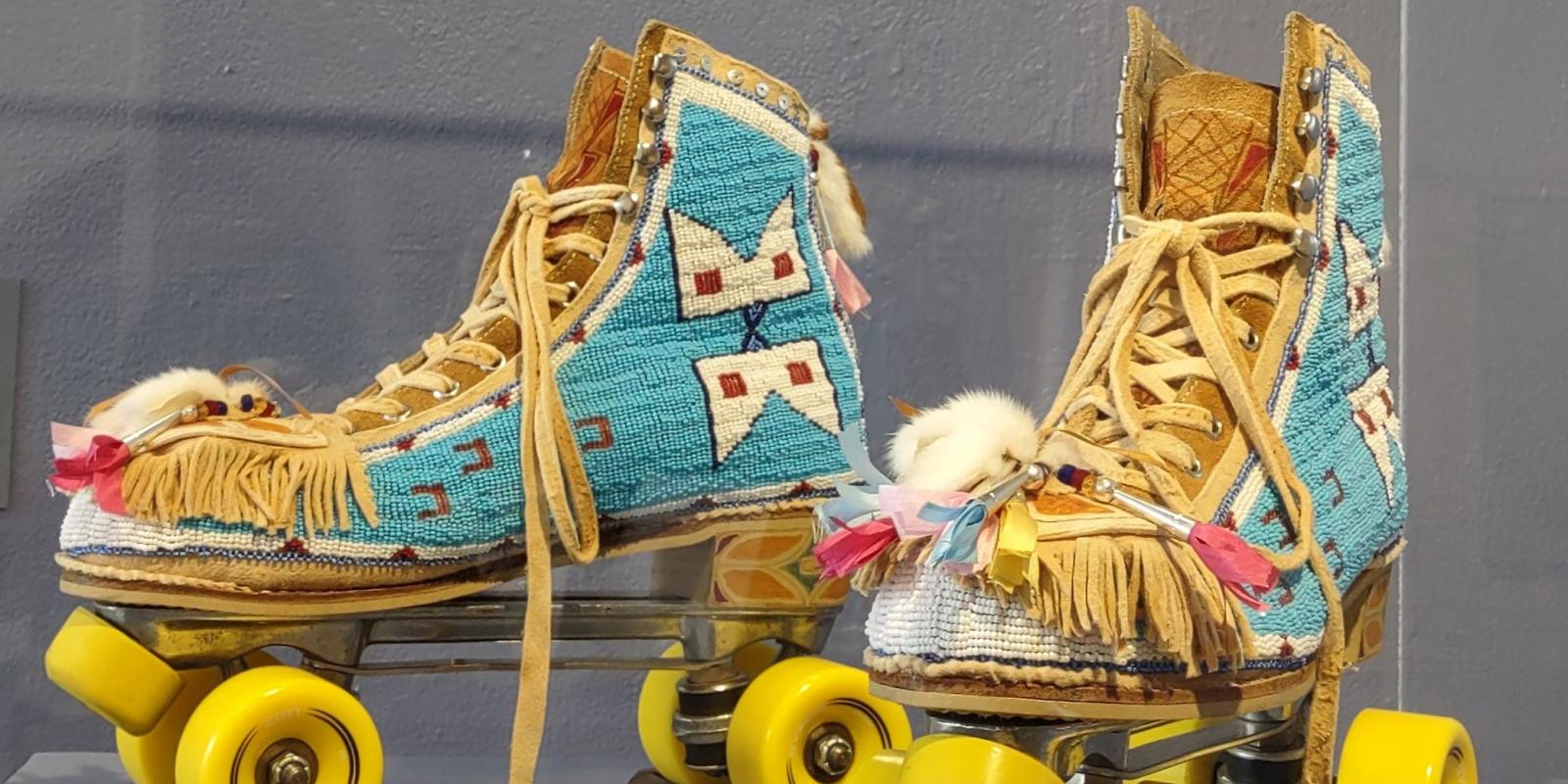
As we made our way back down to ground floor gallery space Camryn Growing Thunder's "Rolling Thunder" beaded roller-skates in vivid turquois (with red and white accents) beads against moccasin grade leather and bright yellow wheels. Her art playfully pulls the visitor in to appreciate the amount of deep skill, love and labor is required to make such an exceptional piece of art. These rollerskates beg to be viewed from every possible angle.
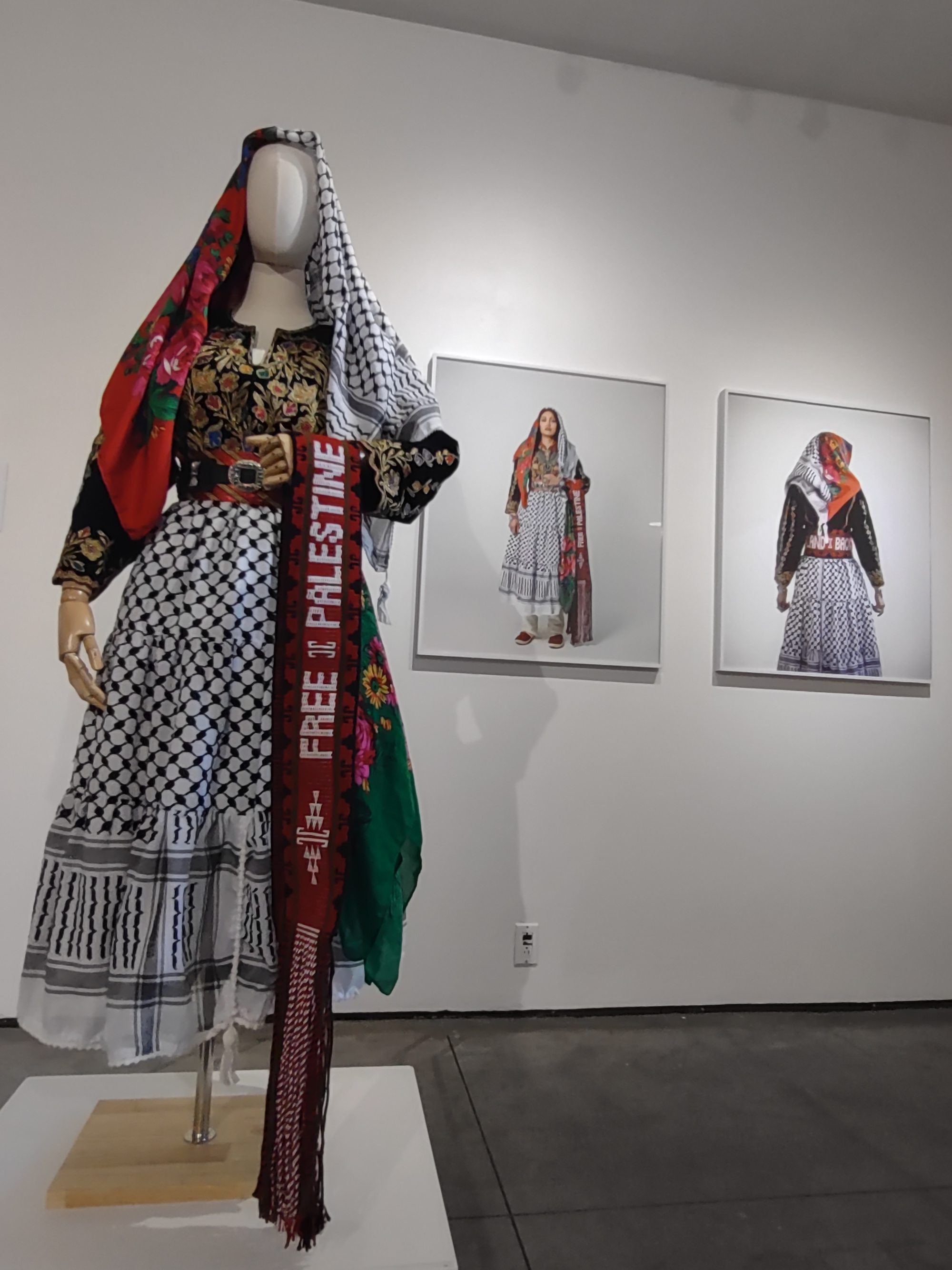 What then captured our attention was a work by Carrie Wood inspired by activism centering support for a "Free Palestine". This undeniably bold fashion statement fused together the traditional floral Diné regalia with the keffiyeh scarves, customarily worn in Palestinian culture, incorporated as cloth to create the skirt and half of the hijab. The skirt is belted with a sash woven by Kevin Aspass, a Diné weaver, that has "Free Palestine" woven in white down to the fringe of the belt held intentionally in the hand of the mannequin. The back of the belt reads "Land Back" representing an ongoing movement by Native American communities across Turtle Island to reclaim lands stolen through colonization. The red, black, green and white colors in the belt carry significance in both Southwest Indigenous cultures and Palestinian lands (apparent in the flag) in solidarity between the two. The overall effect signals the connection between Indigenous peoples who have both been impacted by punitive governments in their homelands in both hemispheres.
In a more whimsical installation, Wood created regalia made completely of red corn husks, that reads as a real haute couture statement with creviced texture that read as 1920's Fortuny pleats and invites the visitor to examine more closely to see how this goddess garment could have possibly been assembled. In the background the regalia is haloed with a wall installation of a ring of multi-colored corn that is a traditional food for Tribal Nations of the region.
"The Armor We Wear" and "Spirit House" are on view at 516 Arts in downtown Albuquerque (ABQ) through January 2026.