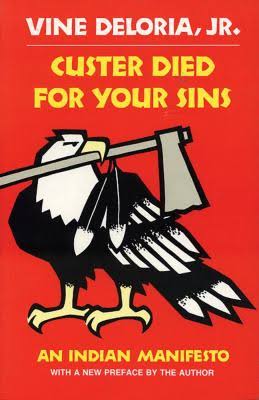
Growing up we had Vine Deloria's "Custer Died for Your Sins" prominent in our psyche from family having copies of the book around the house and attending annual Vine Deloria Symposiums at Northwest Indian College. Because of that background, in these increasingly harrowing times we felt an urgency to share a mantra of resistance and resilience, so as we discussed this with our family of artists we remembered "Warrior Up" (lovingly encouraging words from our Coast Salish family) as the most profound way to remind our Indigenous communities throughout Turtle Island of the strength we have always had to actively and courageously endure through the biggest challenges. It wasn't lost on us that one of the biggest victories for Intertribal solidarity occurred this time of year 150 years ago on June 25-26 at Little Bighorn. This monumental historical victory can be revisited in our darkest hours to remember the phenomenal deeds of strength we can accomplish when we're united against those imperialists who have always sought to divide us.
Rosebud Sioux Tribe Livestreamed Video: 150th Battle of the Little Bighorn Victory Day Celebration

In the early summer of 1876, an immense village of Lakota, Northern Cheyenne, and Arapaho families stood beside the winding water the Lakota called the Greasy Grass. Thousands of people had gathered there beneath cottonwoods and along the broad river valley—children, elders, spiritual leaders, hunters, and warriors living beyond the reservation boundaries imposed by the United States.
On June 25, soldiers appeared along the ridges.
The battle that followed is commonly remembered in American history as the Battle of the Little Bighorn or “Custer’s Last Stand.” To many Lakota and other Plains peoples, however, it remains the Battle of the Greasy Grass: a victory won in defense of families, freedom, sacred lands, and a way of life under relentless attack.
The engagement took place on June 25 and 26, 1876, in what was then southeastern Montana Territory, within the boundaries of the Crow Indian Reservation. Lieutenant Colonel George Armstrong Custer and the United States Army’s 7th Cavalry had been sent as part of a coordinated military campaign against Lakota and Northern Cheyenne people who had refused government orders to enter reservation agencies. Custer divided his regiment and advanced upon the village, apparently underestimating both its size and the number of warriors prepared to defend it.

Lakota, Northern Cheyenne, and Arapaho warriors rapidly organized against the attack. Among those remembered in accounts of the battle are Crazy Horse, Gall, Crow King, Lame White Man, Two Moons, Wooden Leg, and many others whose experiences survive in oral histories, interviews, drawings, and family traditions. Custer and the soldiers under his immediate command were surrounded and killed. Other portions of the regiment, led by Major Marcus Reno and Captain Frederick Benteen, endured prolonged fighting before the Indigenous forces withdrew. By the end of the battle, more than 260 soldiers, scouts, and civilians attached to the 7th Cavalry had died, as had an uncertain number of Indigenous defenders.
The victory at the Greasy Grass was the most dramatic defeat suffered by the United States during the Great Sioux War of 1876–77. Yet the battle cannot be understood simply as a confrontation between two unified sides. The plains and river valleys of the northern West were part of a complex Indigenous world in which territories, hunting grounds, alliances, and rivalries had shifted for generations.
The battlefield lay within territory recognized by the United States as belonging to the Crow Nation under the Fort Laramie Treaty of 1851. During the nineteenth century, Lakota power had expanded westward into lands also used and claimed by Crow, Shoshone, Arikara, and other nations. Some Crow and Arikara men therefore served as scouts with the United States Army, viewing the Lakota and Northern Cheyenne as powerful rivals who had entered or occupied parts of their homelands.
These conflicts, however, did not unfold apart from American colonization. United States expansion transformed every nation involved. Settlers, military forts, railroads, commercial hunters, mining expeditions, epidemics, and federal treaties placed growing pressure on Indigenous lands and economies. Lakota movement westward was partly connected to earlier displacement and competition generated by colonial expansion farther east. The United States then exploited existing rivalries, recruiting Crow and Arikara allies while pursuing its own objective of confining Native peoples to reservations and opening their lands to settlement and resource extraction.
At the heart of the Great Sioux War was the Black Hills, or He Sapa, a sacred center of the Lakota world. The Fort Laramie Treaty of 1868 had recognized the hills as part of the Great Sioux Reservation and restricted unauthorized white settlement. After gold was discovered there during an expedition led by Custer in 1874, miners entered the region in violation of the treaty. Rather than remove them, the federal government attempted to purchase the Black Hills. When Lakota leaders refused, the government ordered Indigenous people living outside reservation agencies to report during the winter of 1875–76—an order that was difficult to receive and nearly impossible for many mobile communities to obey. Their failure to appear was used to justify military action.
The triumph at the Greasy Grass was therefore both a brilliant defense of an Indigenous encampment and a fleeting moment within a much larger colonial war. News of Custer’s defeat shocked the United States and intensified public demands for retaliation. Additional troops entered the region, hunting villages, destroying food supplies, and forcing families to surrender. Within a year, most Lakota and Northern Cheyenne resistance had been broken or driven across the Canadian border. In 1877, the United States seized the Black Hills without the consent required by treaty.
For generations, public memory centered almost entirely upon Custer and the soldiers who died with him. Paintings, films, monuments, and popular histories turned an invasion of an Indigenous village into a heroic national tragedy. Native testimony told another story: of women and children fleeing gunfire, warriors defending their relatives, and sovereign peoples resisting a government that had repeatedly violated its promises.
The landscape itself now carries these layered memories. White stones mark where members of the 7th Cavalry fell, while red granite markers commemorate Lakota and Cheyenne warriors. The Indian Memorial at Little Bighorn Battlefield National Monument honors the Native nations that fought there and bears the words, “Peace Through Unity.”
The Battle of the Greasy Grass endures not merely as the place where Custer fell, but as a testament to Indigenous courage, political independence, and survival. It also reveals the difficult entanglement of Native nations whose older rivalries were reshaped and exploited by an expanding colonial state. To remember the battle fully is to look beyond the mythology of a last stand and recognize the families beside the river, the sacred lands at stake, and the many histories carried across the grass.