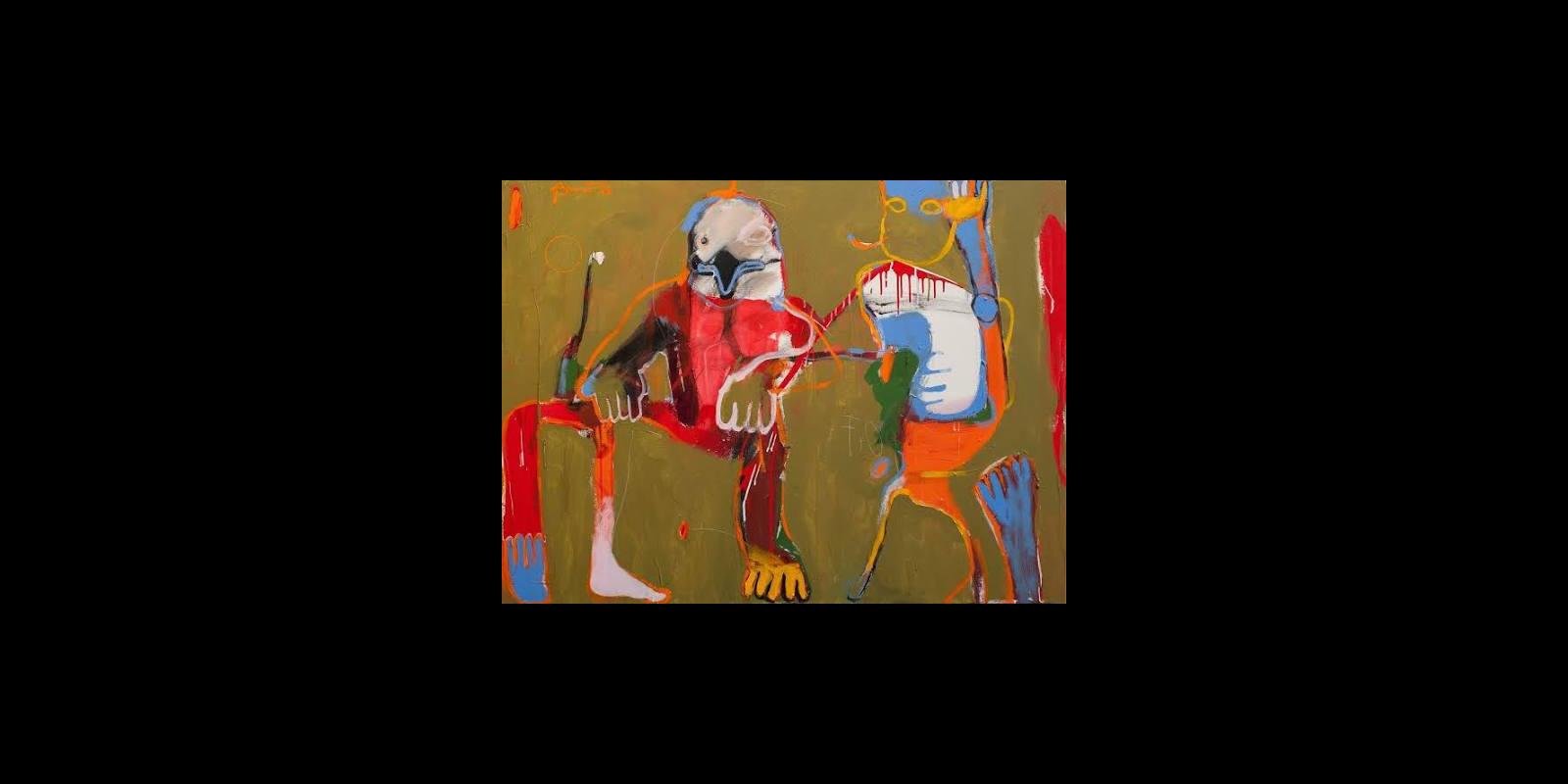
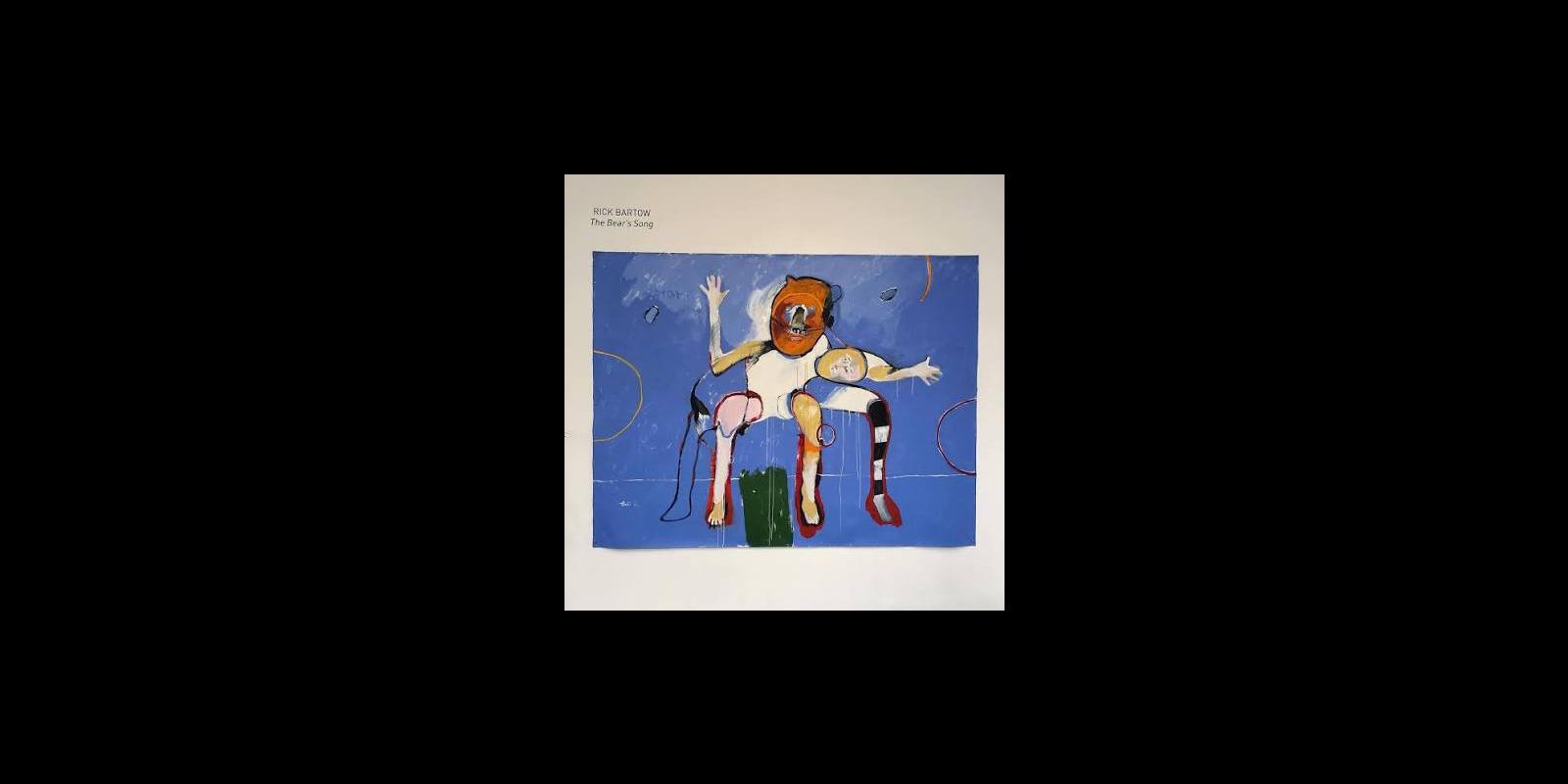
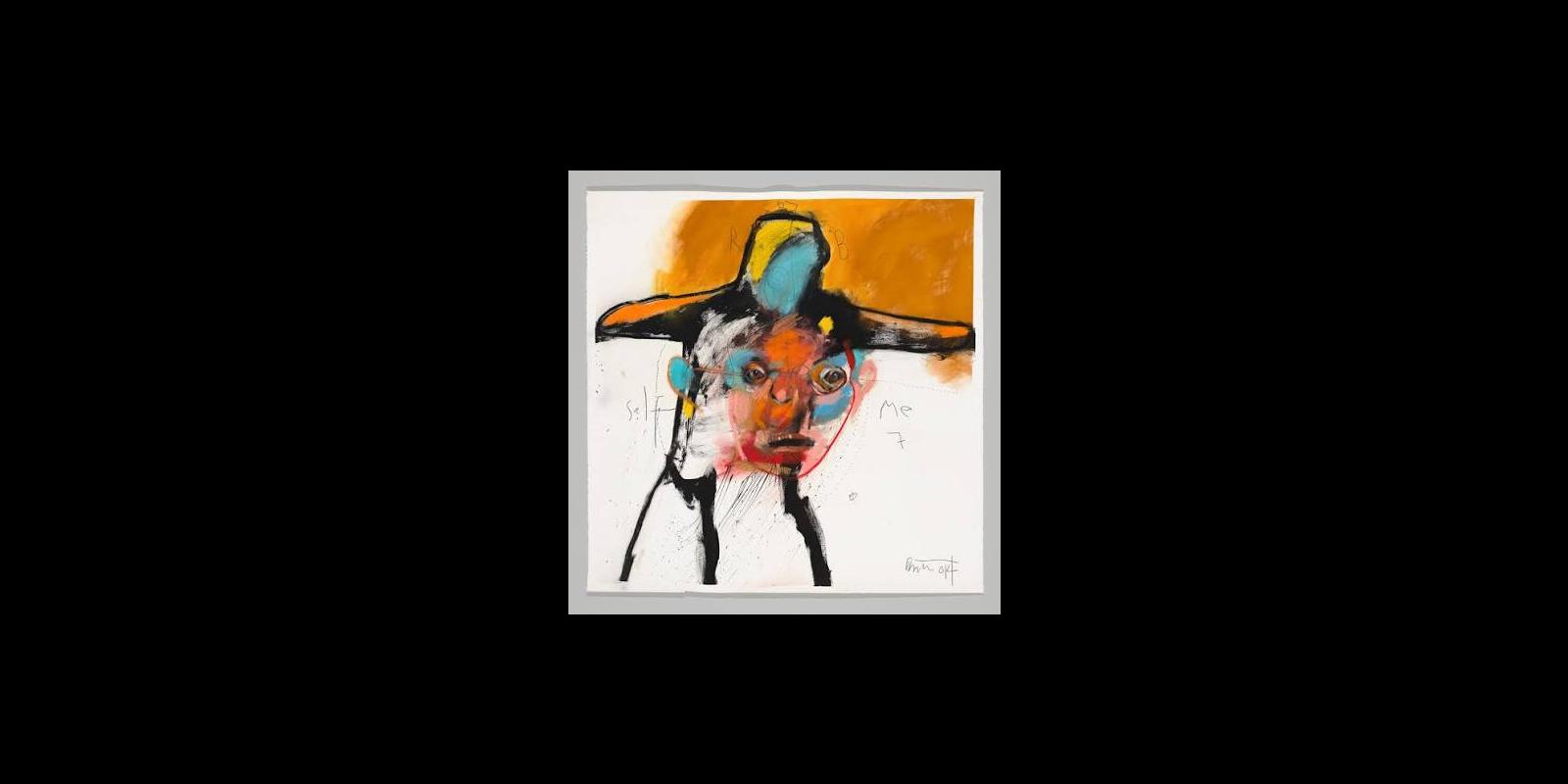
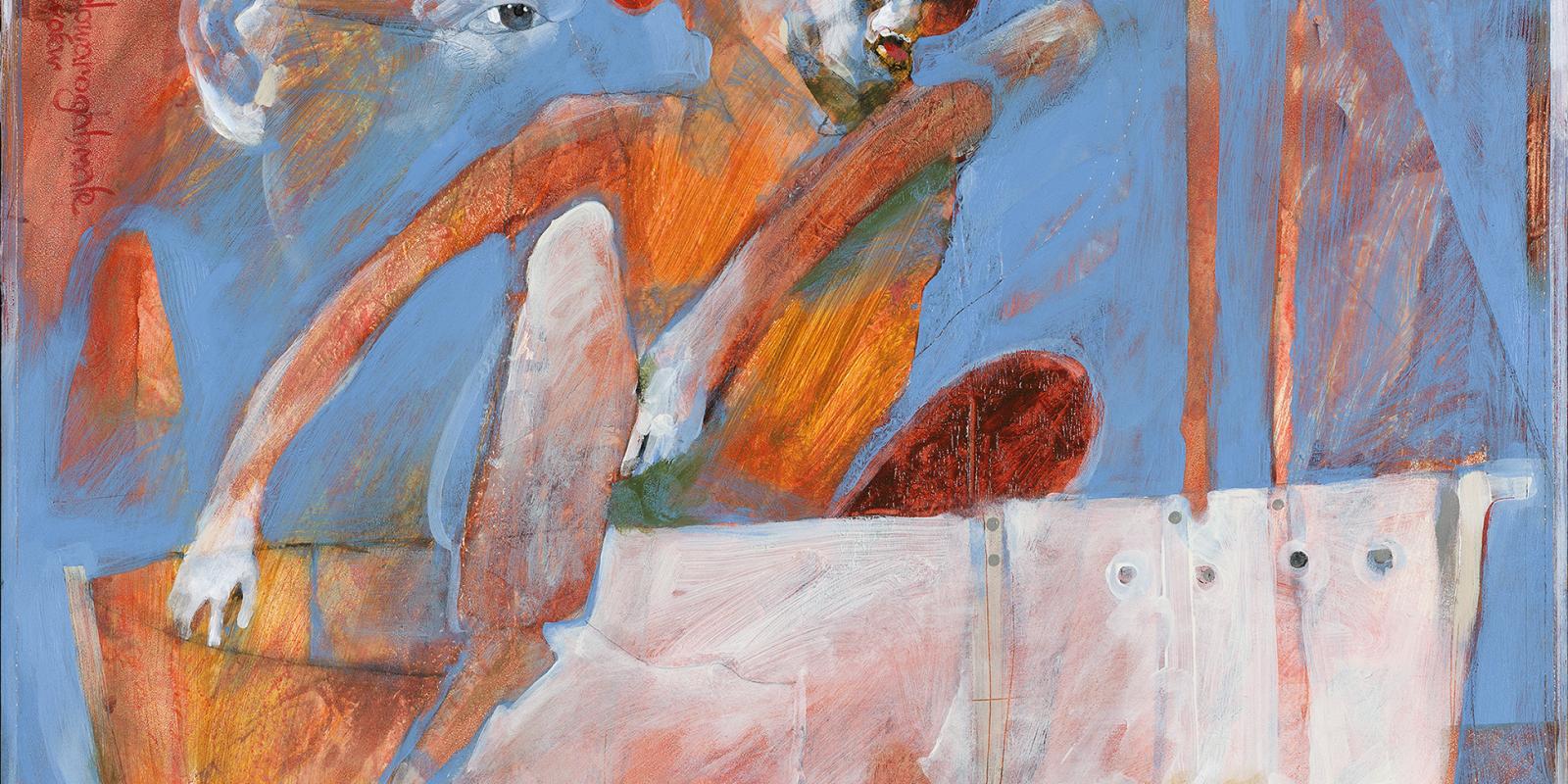
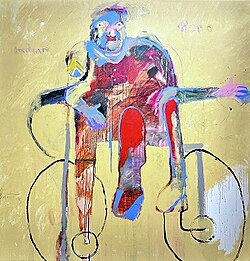
 Richard Elmer “Rick” Bartow (December 16, 1946–April 2, 2016) was a Wiyot artist, musician, Vietnam veteran, and one of the most significant figures in contemporary Native American art. An enrolled member of the Mad River Band of Wiyot Indians, Bartow lived most of his life near Newport on the Oregon coast. His work ranged freely among large pastel and graphite drawings, paintings, prints, carved wood and mixed-media sculpture. Across these forms, he returned again and again to transformation: human faces becoming birds, coyotes, bears, and other beings; bodies dissolving into marks; and identities shifting between the physical, ancestral, emotional, and spiritual worlds. His work is now represented in more than 100 museum and public collections, and during and after his lifetime it has been the subject of more than 100 solo exhibitions. (RICK BARTOW)
Bartow was born in Newport, Oregon, to Mabel and Richard Bartow. His father was Wiyot, and although Bartow grew up away from the Wiyot homeland around Humboldt Bay in northern California, his family maintained Native connections in Oregon, particularly with the Siletz community. Art entered his life early, alongside music. Drawing became one language through which he understood the world; guitar, percussion, singing, and songwriting became another. Those two forms of expression would remain inseparable throughout his life. (Jordan Schnitzer Museum of Art)
In 1969, Bartow graduated from Western Oregon State College, now Western Oregon University, with a degree in secondary art education. Almost immediately afterward, he was drafted into the U.S. Army and sent to Vietnam. He served from 1969 to 1971 as a teletype operator, but he also played guitar and sang with a military band that performed for troops, including badly wounded soldiers in hospitals. The Army awarded him a Bronze Star for this service. The experience left much darker marks. After returning home, Bartow struggled with postwar trauma and addiction, and art became an essential means of rebuilding a life from those experiences. (Eiteljorg Museum)
The rawness of Bartow's drawings is inseparable from this history. Faces emerge from dense fields of graphite and pastel as if they are being rubbed into or out of existence. Eyes stare, mouths open, feathers erupt from skin, and animal forms inhabit human bodies. The images can be frightening, comic, tender, or all three at once. Bartow resisted being confined within a single definition of “Native art.” His visual vocabulary drew from his Wiyot identity and Native Northwest experience while also engaging artists he admired internationally, including Francis Bacon, Marc Chagall, Odilon Redon, and German draftsman Horst Janssen. Relationships with Māori artists, particularly John Bevan Ford, also became important to his understanding of carving, cultural exchange, and Indigenous artistic practice.
Career and Exhibitions
Bartow's national career began to take shape in the 1980s. After exhibiting locally on the Oregon coast, he received a solo exhibition at Jamison/Thomas Gallery in Portland in 1985. The gallery subsequently presented his work in both Portland and New York, helping introduce him to a much wider audience. During the following decade his exhibitions expanded throughout the United States and internationally, including presentations in Seattle, Santa Fe, Vancouver, Frankfurt, Japan, and New Zealand. When Portland dealer William Jamison died in 1995, Bartow began a long professional relationship with Charles Froelick, whose newly established Froelick Gallery opened with a solo exhibition of Bartow's work. Their collaboration continued for the rest of Bartow's life. (Froelick Gallery)
Important exhibitions accumulated steadily. They included Stories at the Schneider Museum of Art in 2000; the 12th Street Series: Rick Bartow at the Tacoma Art Museum in 2001; and Rick Bartow: My Eye, organized by the Hallie Ford Museum of Art in 2002. My Eye surveyed roughly fifteen years of work through approximately forty drawings and twenty sculptures and subsequently traveled to the Museum of Northwest Art in Washington and the Snite Museum of Art at the University of Notre Dame. (Hallie Ford Museum of Art)
In 2003, Bartow was included in Continuum: 12 Artists at the Smithsonian's National Museum of the American Indian's George Gustav Heye Center in New York. Other notable solo presentations included Rick Bartow: Discovery and Fusion at Maryhill Museum of Art in 2003; Bear's Journey at the High Desert Museum in 2004; My Eye at the Northwest Museum of Arts and Culture in 2004; and Tears and Rain: One Artist's View from Sea Level at the Oregon Historical Society in 2006. His exhibitions also reached Mexico and Japan, reflecting the unusually international range of a career still rooted in a small Oregon coastal community. (Froelick Gallery)
The fullest survey of his career came with Rick Bartow: Things You Know But Cannot Explain, organized by the Jordan Schnitzer Museum of Art at the University of Oregon. Opening in 2015, the retrospective brought together more than 120 drawings, paintings, sculptures, and prints spanning nearly four decades. The exhibition examined recurring ideas of gesture, selfhood, dialogue, tradition, and transformation, along with a remarkable body of late work made after Bartow suffered a stroke in 2013. (Jordan Schnitzer Museum of Art)
The exhibition became a national tour extending into 2020, traveling to the Gilcrease Museum in Tulsa; North Dakota Museum of Art; IAIA Museum of Contemporary Native Arts in Santa Fe; Heard Museum in Phoenix; Washington State University Museum of Art; Boise Art Museum; Schingoethe Center at Aurora University; Autry Museum of the American West in Los Angeles; High Desert Museum; and Missoula Art Museum. The scale and geographical reach of the retrospective firmly established Bartow within the larger history of postwar American art rather than solely within the categories of regional or Native art. (Froelick Gallery)
His work has continued to receive substantial attention since his death. The Hallie Ford Museum presented Make Your Mark: Prints from the Rick Bartow Print Archive in 2019, drawing from its extraordinary holdings of more than 400 Bartow prints. The National Museum of the American Indian included him in Stretching the Canvas: Eight Decades of Native Painting, an exhibition examining Native artists who expanded and challenged restrictive definitions of American Indian painting. (Hallie Ford Museum of Art)
More recent exhibitions have included Animal Kinship at the High Desert Museum in 2024 and a 2025 solo presentation at the C.N. Gorman Museum of Native American Art at UC Davis. The Whitney Museum of American Art, which acquired four major Bartow drawings in 2022, included his Autobiographical Hawk in its 2024–2025 exhibition What It Becomes. (Whitney Museum of American Art)
His legacy is receiving one of its most substantial recent presentations in Rick Bartow: Storyteller at the Portland Art Museum, on view from November 2025 through May 2027. Bringing together more than forty works and material relating to Bartow's music, the exhibition emphasizes storytelling as a thread connecting his self-portraits, animal imagery, Wiyot identity, humor, memories, and explorations of Native history and experience. (Portland Art Museum)
Public Art and Commissions
Bartow's monumental carvings carried the transformations of his drawings into physical space. One of the most important was The Cedar Mill Pole, commissioned in 1997 by Washington County and the Oregon College of Art and Craft. Carved from a western red cedar removed during a road project, the approximately 26-foot sculpture transformed a tree lost to development into a public marker of memory, nature, and place. Before its installation in Oregon, the pole was exhibited in the Jacqueline Kennedy Garden at the White House in Washington, D.C. (Clinton White House Archives)
His greatest public commission came from the Smithsonian's National Museum of the American Indian. In 2012 Bartow completed We Were Always Here, a pair of monumental western red cedar sculptures installed beside the museum on the National Mall. Bear and Raven stand at their summits—Bear as a protective, deliberate presence and Raven as trickster, teacher, and agent of transformation. Salmon, water, waves, generations, and the accumulated knowledge held within an ancient cedar all became part of the sculptures' symbolic language. The works were dedicated on September 21, 2012, and remain among Bartow's most visible statements about Indigenous endurance: not disappearance followed by rediscovery, but continued presence. (National Museum of the American Indian)
Bartow's documented commissions also demonstrate the breadth of his practice. They include carved work for the Grand Ronde Tribal Wellness Center and cedar door panels for Paper Nao in Tokyo in 1997; a series of paintings for Shakespeare productions at Newport's Performing Arts Center; a privately commissioned 15-foot cedar pole titled A Story of Water; drypoint editions for Bandon Dunes and a patron print for the Portland Art Museum's Gilkey Center in 2000; three large pastel drawings for the Oregon Convention Center in 2001; and public bronze sculptures commissioned by TriMet in Portland in 2003 and 2009, including a collaboration with artists Lillian Pitt and Ken MacIntosh. (Froelick Gallery)
Additional commissions included artwork for the Ford Alumni Center at the University of Oregon in 2010 and a collaborative carved-wood and cast-glass installation with Nancy Blair for the Center for Health and Nutrition at Western Oregon University in 2011. Earlier projects included carved masks for the Oregon Governor's Arts Awards; lithographs commissioned through the Oregon Arts Commission and Oregon Corrections Division; monumental interior murals for Saks Fifth Avenue in Portland; masks created for the Pacific Dance Ensemble's Journeys; and work for the Washington State Arts Commission's Art in Public Places program. His professional record also lists early commissions from the Oregon Coast Council for the Arts, the Smithsonian, and National Geographic. (Froelick Gallery)
Collections and Legacy
Bartow's work is held by museums and institutions across the United States and abroad, including the National Museum of the American Indian, Whitney Museum of American Art, Brooklyn Museum, Portland Art Museum, Seattle Art Museum, Denver Art Museum, Philadelphia Museum of Art, Yale University Art Gallery, Hallie Ford Museum of Art, Heard Museum, Eiteljorg Museum, Peabody Essex Museum, Crocker Art Museum, Jordan Schnitzer Museum of Art, Gilcrease Museum, Boise Art Museum, Museum of Northwest Art, Tacoma Art Museum, C.N. Gorman Museum, Missoula Art Museum, and numerous university, tribal, civic, and public collections. (Froelick Gallery)
Newport nevertheless remained the center of Bartow's world. He continued to work near the Oregon coast and remained a practicing musician and songwriter, performing guitar and vocals with the Backseat Drivers even after his visual art had gained international recognition. Drawing and music were less separate careers than parallel forms of improvisation: rhythm, repetition, tension, release, and the willingness to follow a line without knowing precisely where it would lead. (Jordan Schnitzer Museum of Art)
Rick Bartow died at his home near Newport on April 2, 2016, at age sixty-nine, from complications of congestive heart failure. (opb) His work, however, continues to resist stillness. Figures become birds; humans become animals; drawings turn into scars and songs. Throughout his career Bartow returned to the difficult territory between loss and survival, humor and suffering, body and spirit. Transformation was not simply one of his subjects. It was the condition through which his art remained alive.
Sources
- Rick Bartow Trust, artist biography and career overview, including exhibition history, collections, and information on the My Eye and Things You Know But Cannot Explain retrospectives. (RICK BARTOW)
- Froelick Gallery, Rick Bartow Artist CV, comprehensive record of solo and group exhibitions, commissions, awards, residencies, and public collections. (Froelick Gallery)
- Jordan Schnitzer Museum of Art, University of Oregon, Rick Bartow: Things You Know But Cannot Explain, exhibition history and biography. (Jordan Schnitzer Museum of Art)
- Smithsonian National Museum of the American Indian, We Were Always Here collection record and Anya Montiel, “Healing By Carving: The Rick Bartow Cedar Poles.” (National Museum of the American Indian)
- White House Historical Archive, “The Cedar Mill Pole – R.E. Bartow.” (Clinton White House Archives)
- Hallie Ford Museum of Art, Willamette University, Rick Bartow: My Eye and Make Your Mark: Prints from the Rick Bartow Print Archive. (Hallie Ford Museum of Art)
- Eiteljorg Contemporary Art Fellowship, Rick Bartow biography and information on his military service and Bronze Star. (Eiteljorg Museum)
- National Museum of the American Indian, Stretching the Canvas: Eight Decades of Native Painting. (National Museum of the American Indian)
- Whitney Museum of American Art, Rick Bartow collection and What It Becomes. (Whitney Museum of American Art)
- Portland Art Museum, Rick Bartow: Storyteller. (Portland Art Museum)
- Oregon Public Broadcasting, reporting on Bartow's life and death. (opb)